
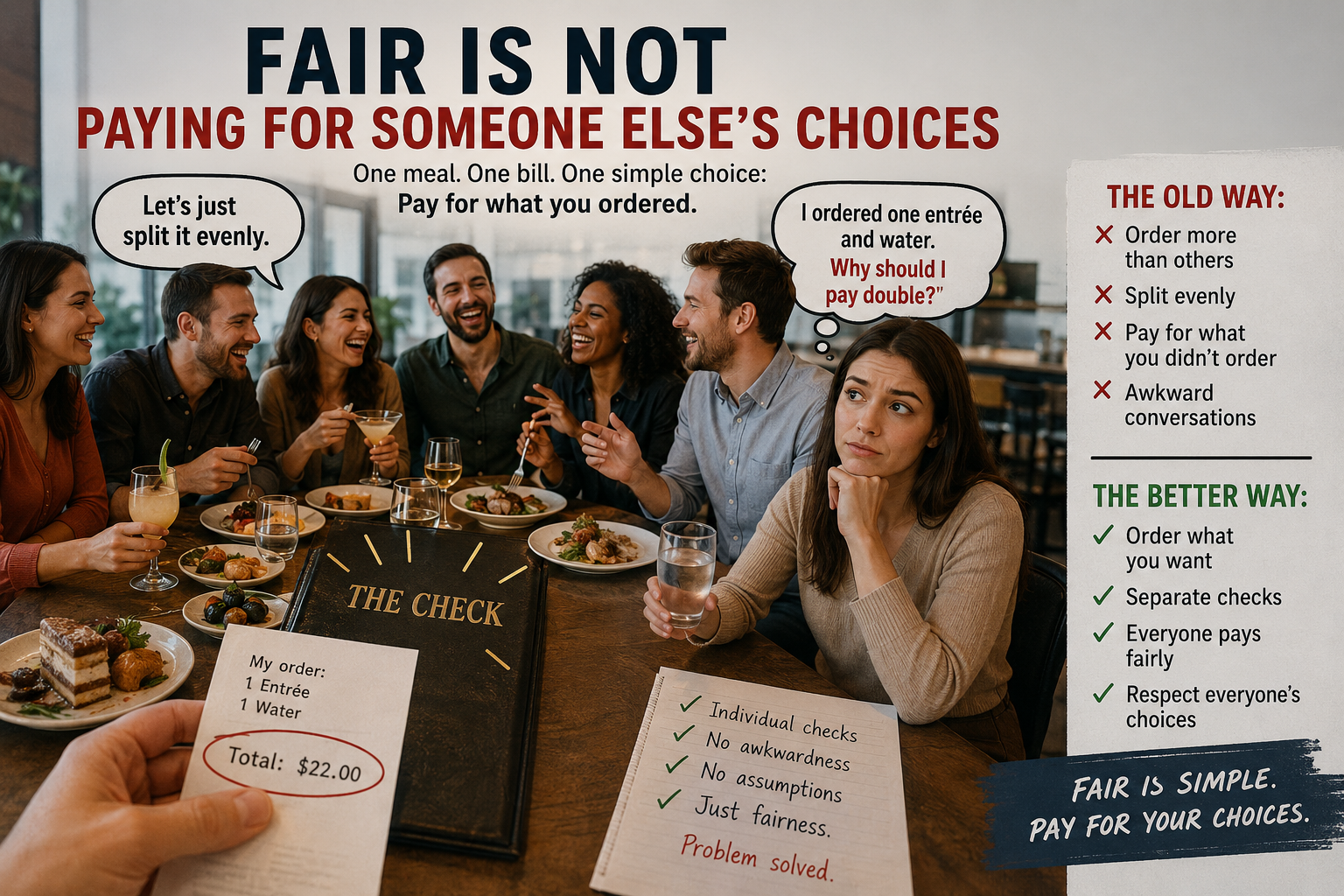
I refused to split the bill after everyone ordered twice as much as I did, and now they say I’m cheap the moment the check hit the table. Everyone suddenly became a huge fan of keeping things simple. Funny how that happened only after they had ordered cocktails, appetizers, desserts, and food to take home.
Meanwhile, I had ordered one entrée and a glass of water. When I refused to split the bill evenly, the mood changed almost instantly. Apparently, standing up for basic math makes you cheap. I’ve never been against splitting restaurant bills. If everyone orders, uh, roughly the same amount, it makes perfect sense.
Nobody has to pull out a calculator. Nobody wastes time sorting receipts. Everyone pays about the same. Easy. The problem is when people use fairness to describe something that obviously isn’t. This dinner started because one of my friends had just received a promotion. A group of eight of us decided to celebrate at a nice restaurant downtown.
Before we even arrived, I already knew I needed to be careful with money. I wasn’t struggling financially, but I had recently paid for unexpected car repairs and was trying to stick to a budget for the month. So before we ordered, I made a simple decision: one entrée, water instead of soda or alcohol, no appetizer, no dessert.
I figured I’d spend around twenty dollars before tax and tip. Completely manageable. Everyone else had very different plans. The appetizers started immediately. “Let’s get a few for the table.” Then someone suggested another round. Cocktails, specialty drinks, premium sides, desserts. Halfway through dinner, a couple of people even ordered extra meals to take home because they might as well.
I didn’t care. People should absolutely order whatever they want. It’s their money. Or so I assumed. Dinner itself was great, shared stories, celebrated our friend’s promotion. Nobody argued. Nobody seemed stressed. Then the server placed the check in the middle of the table. Before anyone even picked it up, one friend smiled and announced, “Let’s just split it evenly.”
Several people immediately nodded. “Yeah, that’s easiest. Nobody wants to do math.” I reached for the receipt. My meal had cost about twenty-two dollars. The total bill divided evenly among eight people meant I’d owe nearly forty-five, almost double. I quietly said, “My order was quite a bit smaller.” One friend laughed, “Oh, come on, it’s only a few extra dollars.”
Another added, “Don’t be that person.” Someone else joked, “We know who’s counting pennies tonight.” Everyone laughed. I smiled politely. But something about the conversation bothered me, not because of the money, because of the logic. The people saying the difference wasn’t important were exactly the people who would save money if I paid extra.
Interesting. If the amount truly wasn’t a big deal, why didn’t they volunteer to cover it? Instead, generosity seemed to mean using my wallet. I calmly said, “I’m happy to pay for exactly what I ordered. Nothing more, nothing less.” The table became noticeably quieter. One friend sighed dramatically, “Seriously?”
Another shook his head, “That’s kind of cheap.” I looked around the table, then asked a simple question, “If I had ordered the most expensive steak, three cocktails, dessert, and food to go, would everyone still want to split evenly?” Silence. Complete silence. Nobody answered because everybody already knew if I had been the expensive diner, they would have wanted individual checks immediately.
Apparently, fairness depended entirely on who benefited. One friend finally muttered, “That’s different.” I smiled. “How?” No answer. At that moment, our server returned. She looked at the table and immediately sensed something awkward. Very politely, she asked, “Would individual checks make things easier?” I answered almost immediately, “That would be great.”
She smiled. “No problem.” Apparently, this happened often enough that she wasn’t surprised at all. She disappeared for a few minutes. When she returned, everyone received their own receipt. The atmosphere changed instantly. One friend looked down and quietly said, “Oh, apparently they’d forgotten about the four cocktails.”
Another suddenly realized their bill included the appetizer they’d insisted everyone share. Someone else’s total was nearly seventy dollars. Mine, twenty-two, exactly what I’d expected. Nobody called me cheap anymore. Instead, everyone became very interested in checking their own receipt carefully. Funny how that works.
One person even laughed awkwardly. “I guess I ordered more than I realized.” Exactly. That’s why separate checks exist. The rest of dinner ended politely enough, but the energy had definitely changed. People left quickly. I honestly assumed that would be the end of it. The next morning, however, one friend texted me privately.
They wrote, “I’ve been thinking about last night. You were right. I honestly didn’t realize how uneven the bill was.” They admitted that suggesting an equal split had simply become a habit, not because they’d intentionally wanted anyone else to pay more, because nobody ever questioned it. That conversation actually made me feel better, not because someone admitted I was right, because someone actually thought about it afterward.
A few others never mentioned the dinner again. One person remained convinced I had embarrassed everyone. Personally, I think basic arithmetic embarrassed them, not me. The interesting part came during our next group dinner a month later. Before anyone even opened the menus, someone asked, “Separate checks?”
Every single person agreed immediately. No debate, no eye rolls, no speeches about generosity. Just, “Sounds good. Problem solved.” That became the new routine. Every dinner after that worked exactly the same way. People ordered whatever they wanted. Nobody judged anyone else’s budget. Nobody subsidized someone else’s expensive tastes.
Oddly enough, it made dinners far more relaxed. There was no silent anxiety when the check arrived, no awkward negotiations. Everyone simply paid for what they chose. Imagine that. Looking back, I think the part that bothered people wasn’t actually the money, it was that I interrupted an expectation.
Somehow I’d become responsible for quietly covering part of everyone else’s choices because saying anything would have been awkward. But awkward for whom? The person paying twice as much? Or the people benefiting from it? Those aren’t the same thing. I also noticed something interesting. People love describing fairness as petty whenever fairness costs them money.
If the numbers had favored me, I would have completely understood everyone wanting separate checks, because that’s actually fair. I don’t expect anyone else to pay for my meal. I don’t expect them to subsidize my choices. Why should the opposite be considered generous? Part of me wishes nobody had called me cheap.
Standing up for yourself shouldn’t require defending your character. At the same time, I learned something valuable. There’s a big difference between being generous and being expected to quietly finance someone else’s decisions. One is a choice, the other is an assumption. Maybe I could have avoided an uncomfortable conversation by paying the extra twenty dollars, but then the same thing would have happened at every future dinner.
Instead, one slightly awkward evening permanently solved the problem. Now everyone pays for what they order. Nobody feels taken advantage of. And strangely enough, the checks have become the easiest part of dinner. Was I wrong?
